🎨 Creative practice πŸ’¬ Public discussion πŸ§ͺ Experimentation

Creative, practitioner & public-facing AI sessions

Bespoke AI sessions for artists, creative practitioners, students, members, professional cohorts and public audiences. Sessions can combine accessible explanation, hands-on experimentation and open discussion around the creative, cultural, ethical and professional questions surrounding AI, shaped around the people taking part and the wider programme, event or context.

About Jocelyn

Jocelyn Burnham is an independent AI consultant and facilitator specialising in arts, culture and heritage. Her public and practitioner-facing work combines accessible explanation, creative experimentation and critical discussion, with sessions designed around the people in the room and the cultural context in which they are taking place.

100+ AI workshops and learning programmes Artists, practitioners & public audiences UK and international
Selected clients
Approach

Sessions built around the people in the room.

These sessions often bring together people with very different relationships to AI. Some may already use generative tools in their creative practice. Others may be encountering them for the first time, or may have strong reservations about their effect on creative work.

The facilitation is neutral towards AI adoption. Enthusiasm, scepticism, discomfort, curiosity and disagreement are all welcome, and nobody needs to arrive wanting to use the technology.

The shape of the session depends on the audience and the occasion. A public programme might need an accessible introduction and room for discussion. A practitioner group might spend more time experimenting with tools, interrogating outputs or exploring how a particular development intersects with their own creative practice.

Sessions can also respond directly to an exhibition, festival, course, artist-development programme, membership offer or particular creative discipline.

The aim is to give people enough understanding, experience and space for discussion to develop their own position and decide what is relevant to their practice.
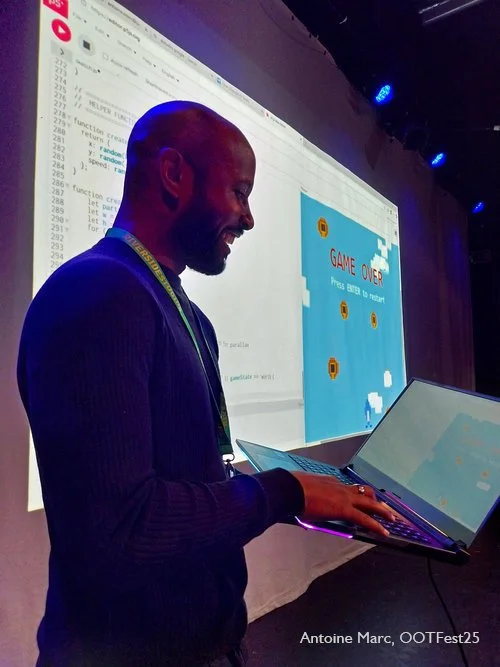
Antoine Marc demonstrating a computer game during a Playful AI session at OOTFest25
Antoine Marc shares an experiment during a Playful AI session at OOTFest25.
Audiences

Designed for the people your organisation works with.

The audience can be a particular professional community, an existing creative cohort, students, members or people encountering the subject through a public cultural programme.

artists creative practitioners students early-career creatives members professional networks creative cohorts festival audiences museum & gallery audiences community groups public programmes mixed cultural audiences
Session possibilities

Different ways a session can work.

The content can be assembled differently depending on whether the emphasis is creative practice, public understanding, professional development or exploratory work around a particular question.

Accessible introductions

Clear explanations of current AI systems, what they can and cannot do, and the cultural questions surrounding them, without assuming previous technical knowledge.

Creative experimentation

Hands-on exploration using text, image, audio, video, coding or other tools where they are relevant to the group and the questions people want to investigate.

Practitioner labs

Longer sessions where artists and practitioners can investigate a technology or creative question through their own work, compare approaches and reflect on what they find.

Facilitated discussion

Structured conversations around authorship, labour, consent, copyright, creative quality, representation and the changing conditions in which cultural work is made.

Member and cohort sessions

Shared learning for professional associations, networks, development programmes and groups brought together around a particular discipline or area of practice.

Programme-specific activity

Sessions developed around an exhibition, performance, course, festival, residency, public programme or other existing cultural context.

Creative practice

AI as a creative and cultural question.

For artists and creative practitioners, understanding the technology is only part of the conversation. A session can also explore how AI interacts with authorship, originality, artistic identity, professional skill, consent and the relationship between a practitioner and their audience.

Practical experimentation gives people something concrete to respond to. Participants can examine the quality of an output, decide what kinds of creative contribution they value, identify where a tool conflicts with their practice and explore questions that are difficult to settle through abstract discussion alone.

The emphasis can move towards the questions most relevant to a particular artform, discipline or group.

authorship originality style training data creative labour consent voice & likeness copyright artistic identity creative quality representation environment
Formats

From a single event to a longer programme.

Sessions can be short and introductory, highly participatory or developed over a longer period. The appropriate structure depends on the audience, the context and how much practical activity the host wants to include.

  • Artist and practitioner workshops
  • Creative labs
  • Student sessions
  • Member and network events
  • Public workshops and participatory events
  • Festival and conference sessions
  • Residency and artist-development support
  • Multi-session learning programmes
Practical details

The format follows the audience.

Previous AI experience is not required. Practical sessions can be designed for participants using their own laptops, shared devices or demonstrations, depending on the setting and the level of participation required.

Sessions can take place online or in person. For public events, the amount of technical participation can be adjusted to suit the venue, audience size, access requirements and available equipment.

Where a session forms part of a wider programme, I can work with the host organisation to develop the framing, activity and emphasis around that context.

Participant response
β€œThe session with Jocelyn was straight off the bat engaging and perspective changing.”
Nathan Holt Β· Artist
Common questions

Questions that often come up.

Do participants need previous AI experience?
No. A session can begin with the shared knowledge the group needs before moving into discussion or experimentation. Groups with mixed levels of experience are common.
Can people take part if they are critical of AI?
Yes. The facilitation is neutral towards AI adoption and different views are actively welcomed. Participants can investigate the technology, challenge particular uses and decide that some or all of it has little relevance to their practice.
Can the session connect to an exhibition, artform or programme?
Yes. The framing, examples, practical activity and discussion can be developed around a particular exhibition, performance, discipline, festival, course, residency or wider programme.
Does everyone need a laptop?
No. Some sessions benefit from individual devices, while others can use demonstrations, shared experiments or discussion-led activity. The format can be designed around the venue and audience.
Can you work with artists who already use AI?
Yes. Sessions can move beyond introductory material and concentrate on a particular creative question, emerging capability, area of practice or experimental process.
Can this be part of a residency or artist-development programme?
Yes. I can contribute a single session, work with a cohort over several stages or support practitioners as they develop individual experiments and questions through a wider programme.
What if we primarily need a keynote or talk?
Public sessions can include substantial presentation and discussion, but standalone keynotes and speaking engagements have a separate format. You can find more information on the Speaking Engagements page.
Planning a session 20-minute introduction call

Tell me about the audience and the occasion.

A few details are enough to start. Who the session is for, what the wider programme or event is, how participatory you want it to be and any particular questions you want to explore will help me suggest an appropriate format.

Creative, practitioner and public-facing sessions are available online and in person in the UK and internationally.